EU legal guarantee guides
The EU 2-year warranty law: the legal guarantee of conformity
Every consumer in the EU has a legal guarantee of at least two years on goods. Who is liable, what the consumer can ask for, how the burden of proof works, and how the period differs by country.
Last reviewed: · Transactful
People call it the EU 2-year warranty. The law calls it the legal guarantee of conformity. It comes from Directive (EU) 2019/771, every EU country has it in its own law, and it gives every consumer at least two years of protection against faulty goods, at no cost.
The rule in short
- The seller is liable, not the manufacturer.
- The seller is liable for any lack of conformity that exists at delivery and becomes apparent within at least two years.
- The consumer gets repair or replacement first, free of charge. If that is impossible, fails, or takes too long, the consumer can have a price reduction or end the contract for a refund.
- For a fault that appears in the first year, the law presumes it existed at delivery. The seller must prove otherwise. Some countries extend this to two years.
- It cannot be excluded by the terms of sale.
What “lack of conformity” means
Goods are in conformity when they match the contract and what a consumer can reasonably expect. A product fails that test when it:
- is faulty or breaks under normal use;
- does not match the description, sample or model shown;
- lacks the quality, durability or functions normal for that type of good;
- comes without the accessories, instructions or updates it should have;
- was installed badly by the seller, or with faulty instructions.
The period by country
Directive 2019/771 sets a minimum. Countries can go further, and several do. A summary for some countries, for new goods sold to consumers:
| Country | Liability period | Presumption of fault at delivery |
|---|---|---|
| Germany | 2 years | 1 year |
| France | 2 years | 2 years (1 year for second-hand goods) |
| Italy | 2 years | 1 year |
| Spain | 3 years | 2 years |
| Portugal | 3 years | 2 years |
| Sweden | 3 years | 2 years |
| Netherlands | No fixed period: the expected lifespan of the good | 1 year |
| Ireland | Claims within 6 years | 1 year |
| Poland | 2 years | 2 years |
Check the national law before you rely on a figure: these are summaries, and the details (second-hand goods, notification rules, limitation periods) differ. The Your Europe guarantees page lists every country.
Legal guarantee, commercial guarantee, warranty
A commercial guarantee (often called a warranty) is a promise a business makes voluntarily, on its own terms: a manufacturer’s warranty, a shop’s extended warranty, a paid protection plan. It comes on top of the legal guarantee and never replaces it. Read legal guarantee vs commercial guarantee.
What changes in 2026
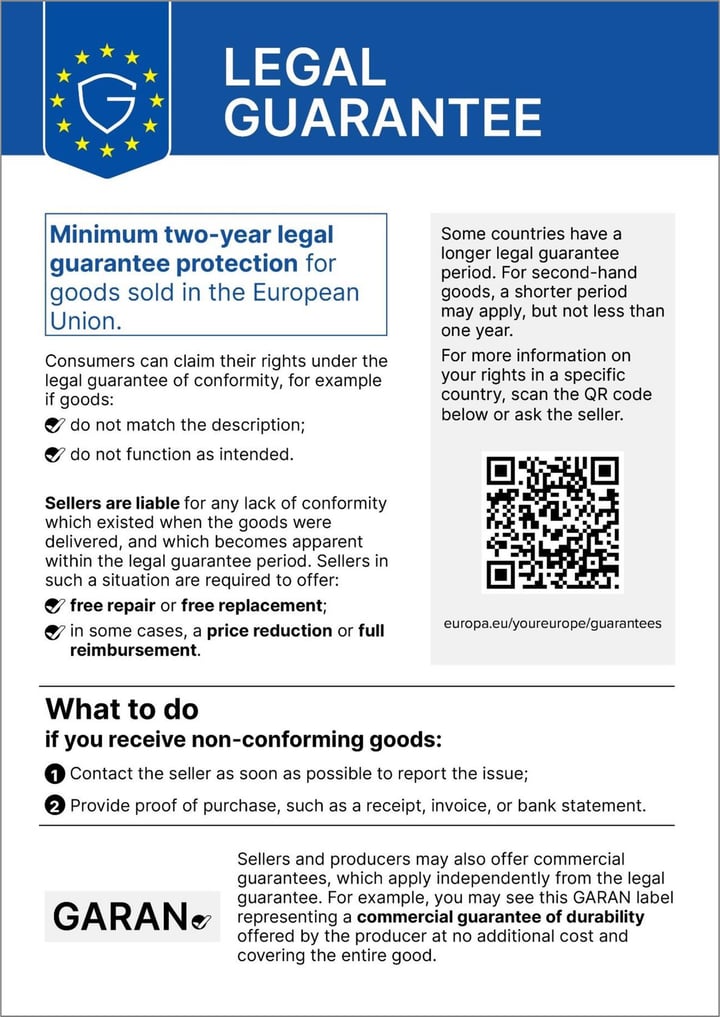
The rights stay the same. What changes is that sellers must tell consumers about them. From 27 September 2026, every seller of goods to EU consumers must show the harmonised legal guarantee notice before purchase, in the consumer’s language, using the official design from Regulation (EU) 2025/1960.
For online shops
- Honour the legal guarantee for every consumer in the EU, with the period of the consumer’s country where it is longer.
- Do not describe a commercial warranty as if it were the legal guarantee, and do not sell an extended warranty as cover the consumer already has by law.
- Show the harmonised notice on each product page. On Shopify, Assay does this in all 24 EU languages; the free plan covers it.
Frequently asked questions
Is there a 2-year warranty in the EU?
Yes. Under Directive (EU) 2019/771 the seller is liable for any lack of conformity that becomes apparent within at least two years of delivery. It is called the legal guarantee of conformity, and it is free and automatic.
Is the legal guarantee the same as a manufacturer's warranty?
No. The legal guarantee is a right against the seller and comes from the law. A manufacturer's warranty is a voluntary commercial guarantee, on top of the legal one, on the terms the manufacturer sets.
Who pays for repairs under the legal guarantee?
The seller. Repair or replacement must be free of charge for the consumer, including the costs of shipping, labour and materials.
Does the 2-year guarantee apply to second-hand goods?
Yes, but EU countries can let seller and consumer agree a shorter period for second-hand goods, not less than one year.
Can a seller exclude the legal guarantee in its terms?
No. A term that excludes or limits the legal guarantee against a consumer is not binding on the consumer.
Does the legal guarantee cover normal wear and tear or misuse?
No. It covers goods that were not in conformity at delivery: faulty, not as described, or not fit for normal use. Damage caused later by the consumer is not covered.
Sources
This guide summarises EU and national law for online sellers. It is not legal advice. Check the sources, and ask an adviser about your own business.