EU legal guarantee guides
The EU legal guarantee notice: a guide for online shops
From 27 September 2026, shops that sell goods to consumers in the EU must show a harmonised legal guarantee notice before purchase. What the notice is, who must show it, where it goes, and how to add it.
Last reviewed: · Transactful
Every consumer in the EU has a legal guarantee of at least two years on the goods they buy. Few of them know it. From 27 September 2026, the EU makes sellers tell them, with one notice that looks the same in every shop and every country: the harmonised legal guarantee notice.
This guide covers what the notice is, the law behind it, who must show it, and how to put it on an online shop.
What the notice is
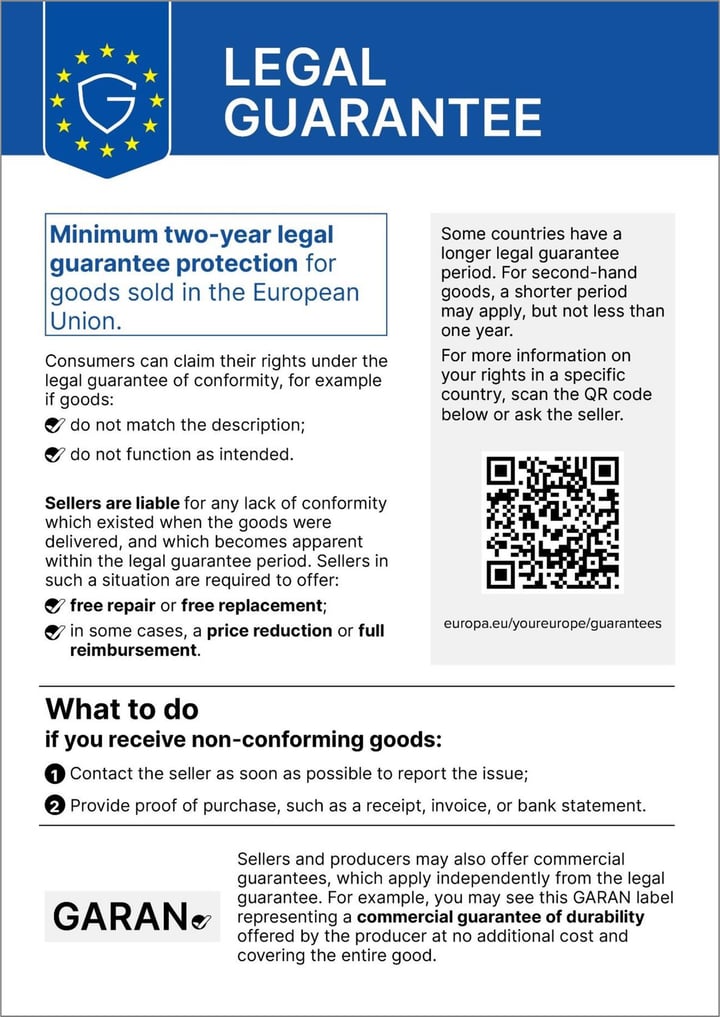
The notice is a fixed image published by the European Commission. It tells the consumer, in their language, that:
- the seller is liable when goods are faulty or do not match the description, for at least two years;
- the consumer can ask for a remedy: repair, replacement, a price reduction or a refund;
- national law can make the guarantee last longer;
- sellers and producers can offer a commercial guarantee in addition;
- more information is on the EU’s Your Europe portal, through a QR code.
It exists in all 24 official EU languages. The text, layout, colours and QR code are part of the official artwork, and the regulation says none of its elements may be edited. Online it must be shown in colour, and its QR code must scan on a normal phone. In a physical shop it is printed at A4 or larger.
The law behind it
Three EU acts work together:
| Act | What it does |
|---|---|
| Directive (EU) 2019/771 | Sets the legal guarantee itself: at least two years of seller liability for goods. |
| Directive (EU) 2024/825 | Amends the Consumer Rights Directive. Sellers must inform consumers about the legal guarantee with a harmonised notice, and about some commercial guarantees with a harmonised label. |
| Regulation (EU) 2025/1960 | Fixes the design and content of the notice and the label, in every language. |
The directive and the regulation both apply from 27 September 2026. Each EU country sets its own penalties.
Who must show it
Traders that sell goods to consumers in the EU. That covers:
- online shops, marketplace sellers and social commerce sellers;
- physical shops;
- shops based outside the EU that sell to consumers in the EU.
Business-to-business sales are out of scope. Services and digital content have their own rules and are not what the notice is about.
Where it goes on an online shop
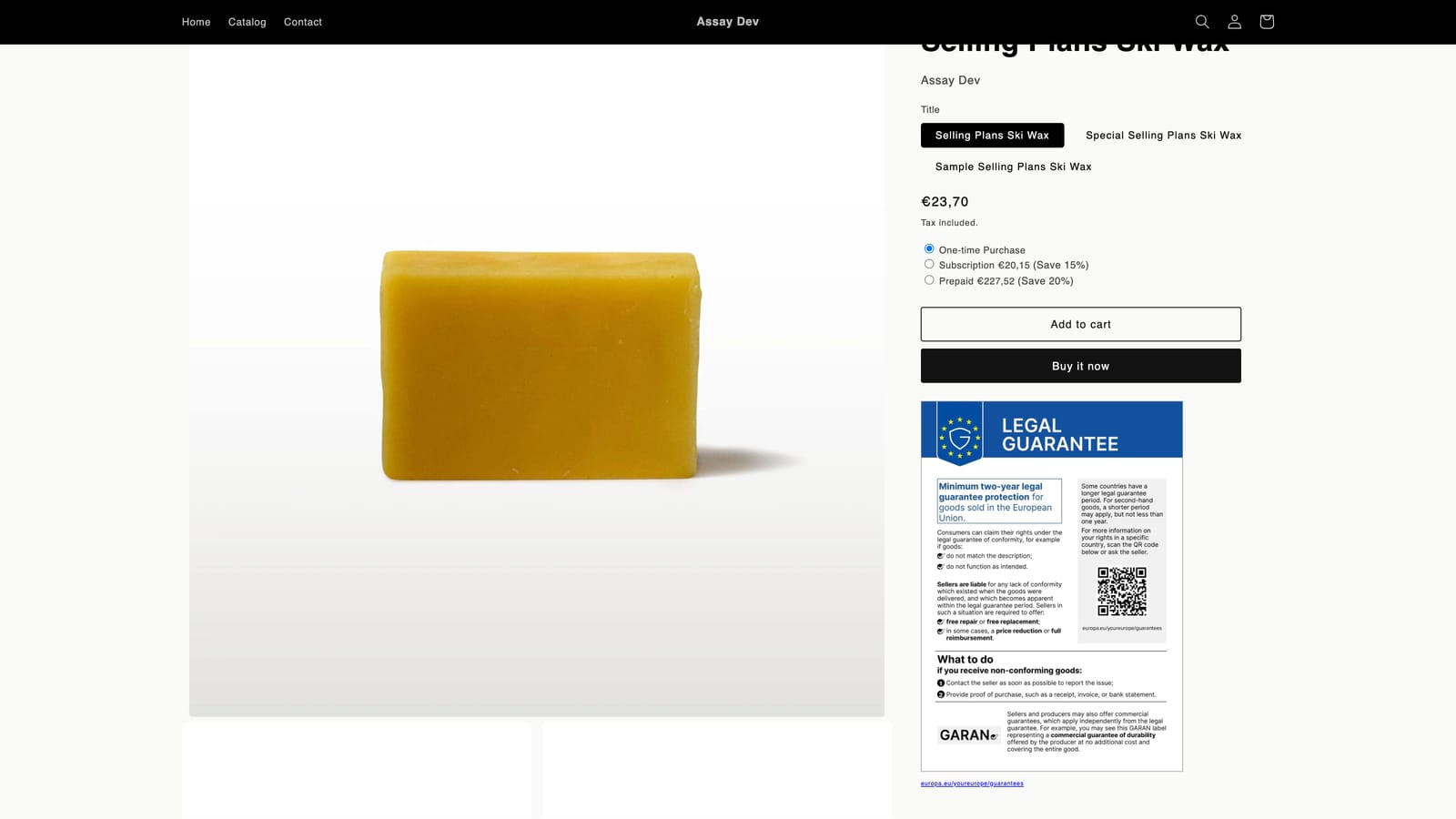
The notice is pre-contractual information: the consumer must see it before they are bound by the contract, and in a prominent manner. For an online shop, the natural place is the product page, near the price and the buy buttons. A link in the footer or a line in the terms of sale is not the harmonised notice.
Show it in the language of the consumer. A shop that sells in French and German shows the French notice to French-speaking shoppers and the German notice to German-speaking ones.
The GARAN label: the second piece
The same regulation defines a harmonised label for a producer’s commercial guarantee of durability. It is only for goods whose producer guarantees, free of charge, that the whole good will last more than two years. It shows the number of years, the producer and the model. When the producer offers such a guarantee and gives the seller that information, the seller must show the label. Most products do not qualify, and showing the label without a real guarantee is a misleading claim. Read the GARAN label guide.
How to add the notice
- Get the official artwork in each language you sell in, from the Official Journal.
- Place it on every product page, before the buy button, at a size where the text is readable.
- Match the language to the shopper’s language.
- Check it on a real product page, on desktop and on a phone.
- Keep it current. Show the GARAN label only on products with a qualifying producer guarantee.
On Shopify, the Assay app does steps 1 to 4 for you: it adds the official notice to every product page, in all 24 languages, matched to the shopper’s language. The free plan covers the notice. See how to add the notice to a Shopify store for the other options too.
The notice by country
The notice is the same everywhere, but the legal guarantee behind it is national law. Some countries give more than two years, and each language has its own words for it:
- Germany, Austria: Gesetzliche Gewährleistung
- France, Belgium, Luxembourg: Garantie légale de conformité
- Italy: Garanzia legale di conformità
- Spain: Garantía legal
- Netherlands, Belgium: Wettelijke garantie
- Poland: Rękojmia i niezgodność towaru z umową
For a summary of the periods in each country, read the EU 2-year warranty law.
All guides
Frequently asked questions
Is the EU legal guarantee notice mandatory?
Yes, for traders that sell goods to consumers in the EU. Directive (EU) 2024/825 makes the notice part of the information a consumer gets before the contract, and Regulation (EU) 2025/1960 fixes its design. Both apply from 27 September 2026.
Where must the notice appear in an online shop?
Before the consumer is bound by the contract, in a prominent manner. For an online shop, the product page is the usual place, close to the price and the buy button.
Can I redesign the notice or translate it myself?
No. The regulation says none of the notice's elements may be edited. The EU publishes it in all 24 official languages; use the official version in the language of the consumer.
Does the notice change the length of the legal guarantee?
No. The notice only informs consumers about rights they already have under Directive (EU) 2019/771 and national law: at least two years in every EU country, longer in some.
Do shops outside the EU need it?
In general, yes, when they sell goods to consumers in the EU. EU consumer law protects consumers in the EU whichever country the shop is in.
What is the GARAN label?
A second artefact from the same regulation. It shows a producer's commercial guarantee of durability that is free, covers the whole good and lasts more than two years. When the producer offers one and tells the seller, the seller must show the label. Most products do not have one, and the label is only lawful when they do.
Sources
This guide summarises EU and national law for online sellers. It is not legal advice. Check the sources, and ask an adviser about your own business.